
Pedro Ramírez Vázquez. Mexico's other modernist.
Updated: Apr 4

It’s officially spring now; the days are getting longer, the sun is shining and flowers are blooming. Although its still chilly here in Boston, the sunshine and longer days have me thinking about Mexico City- one of my favorite cities. Not only does Mexico City have fantastic mid-century and modernist architecture but it’s also home to some of the world’s best cocktail bars. Handshake Speakeasy has been named the best cocktail bar in North America by Conde Nast and Licoricia Limantour has long been a favorite of every cocktail connoisseur that I know, especially Mr. Don’t Bruise the Booze. The combination of great cocktail bars and spectacular modern architecture really hits the sweet spot, like the perfect Abasolo Old-Fashioned.

When most people thing of Mexican modernism, they think of the architect Luis Barragán. However Pedro Ramírez Vázquez is Mexico’s most prolific modernist architect although he ist little known outside of Mexico. The National Museum of Anthropology in Mexico city, is perhaps the most familiar Vázquez project to American readers. Located in Chapultepec park and sitting on a raised plaza surrounded by beautiful gardens it is a gorgeous building. The museum is designed around a central courtyard with an enormous central pillar, with a tree-like canopy that simultaneously acts like a downspout and a fountain during rain storms. This remarkable feature has become one of the most popular “selfie spots” in Mexico City. Referencing classic colonial Mexican design, the galleries open onto the courtyard, allowing for cross ventilation and access to the courtyard from the galleries. But it is the wonderful mix of mid-century modern design with Aztec references that makes the building such an iconic example of Mexican mid-century modern architecture.

Pedro Ramírez Vázquez was born in 1919, at the end of the Mexican revolution. His father was a bookseller in the historic center of Mexico city and he grew up in an intellectual family. His two brothers became lawyers and he studied architecture at the National Autonomous University of Mexico, (UNAM) graduating in 1943. His career lasted from 1943 until his death in 2013 at the age of ninety-four. His office was incredibly prolific, designing thousands of projects. His design for the Mexican pavilions at the World’s Fairs in Brussels, Seattle, and New York brought him both international acclaim but also the experience directing large, international teams. It was this experience that enabled him to organize and direct the 1968 summer Olympics in Mexico City as president of the organizing committee for the Olympics. He oversaw the design and construction of all the games facilities and venues and even was involved in the graphic design and branding, along with an international design team.

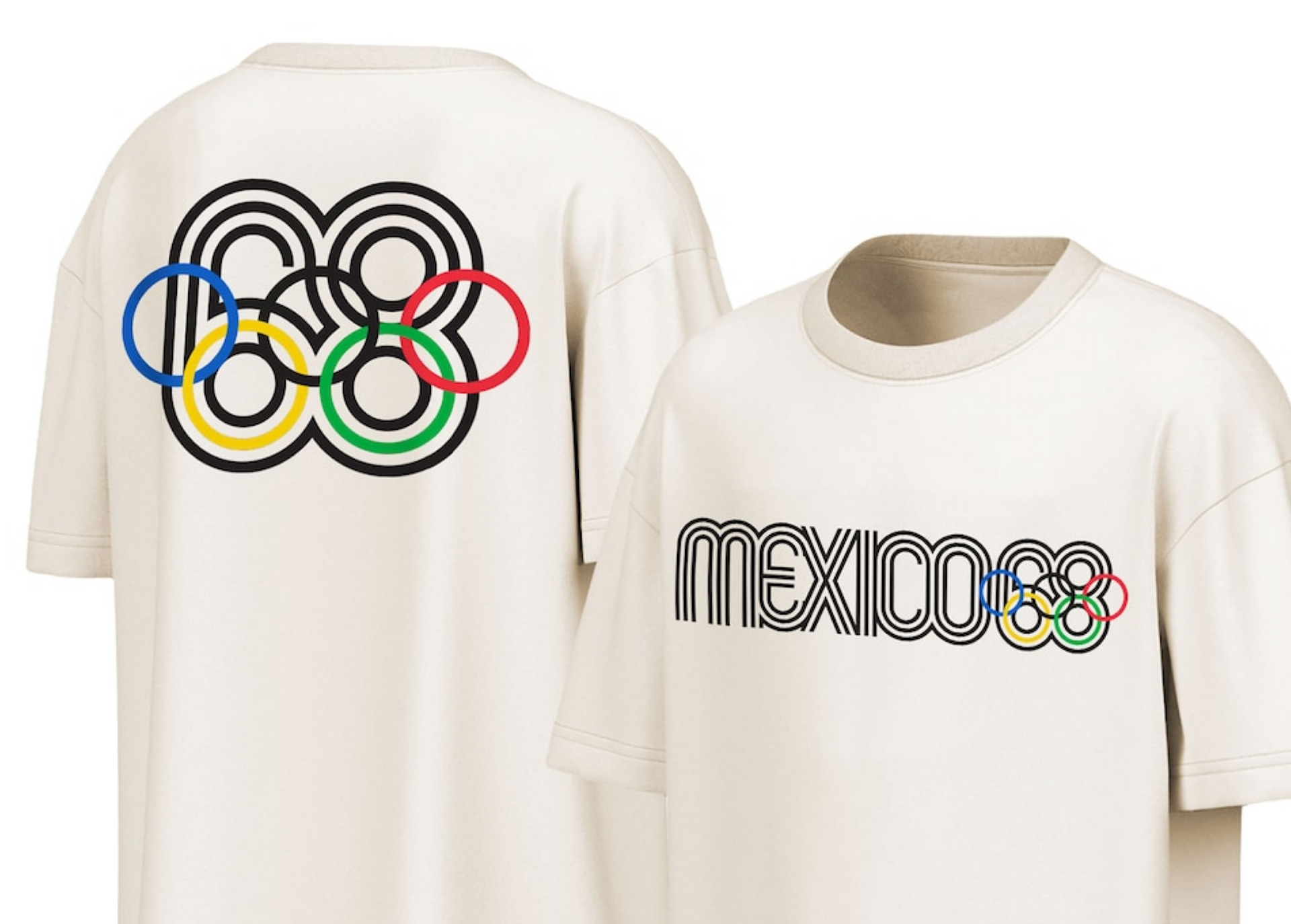
The Mexico City Olympics were a showcase of Mexican modernism. From the pink and orange op-art inspired ground covering to the use of lava stone and mortar in the construction of the Olympic stadium, and the use of imagery and colors inspired by the diverse indigenous art of Mexico, Pedro Ramírez Vázquez wanted the Olympics to highlight Mexico's rich culture of art and design to the world. And he succeeded brilliantly. The design and graphics of the 1968 Mexico City summer Olympics are perhaps the most recognizable and studied designs of any Olympics.
The design team was an international group spearheaded by Vázquez to include Mexican artists Edouardo Terrazas, and Mathias Goeritz ( who worked heavily with Barragán), and American graphic designers Peter Murdoch and Lance Wyman.

Pedro Ramírez Vázquez invited American designers Lance Wyman and Peter Murdoch to submit a design for the graphics, giving them two weeks to come up with something.
"It was a daunting challenge, and in some sense, a very open-ended assignment. I traveled to Mexico with Peter Murdoch and my wife of two months, Neila, to participate in a competitive arrangement—we had two weeks to come up with something, and if we didn’t, we would go home. It didn’t help, in terms of stress, that all we could afford were one-way tickets to get down there."1.
Miraculously Peter Murdoch and Lance Wyman managed to come up with the now iconic font inspired by Huichol weaving and Op-Art and ended up staying in Mexico City for two years as part of the design committee.

The 1968 Olympics in Mexico city were overshadowed by the Tlatelolco massacre which took place only ten days prior to the opening ceremony. After months of protest thousands of students gathered in the Plaza de las Tres Culturas in Tlatelolco, where the Olympics were taking place, to use the spotlight to highlight their struggle for democracy and civil rights. Government forces shot and killed hundreds of protestors. As a government agent, Pedro Ramírez Vázquez , was seen as complicit in these massacres. According to his obituary in the New York Times, he defended the government's killings and characterized the protestors as violent, claiming that foreign journalists exaggerated the bloodshed.

Despite this stain on his reputation, Vázquez’ office went on to design numerous modern buildings that changed the face of Mexico City. Unlike most modernist architects (or architects in general) he was very interested in public policy and realized how important it was for government and architecture to work together to solve urban planning dilemmas. In 1976 he was made the head of the department of Human Settlement and Public Works and was responsible for the construction of thousands of schools in rural communities throughout Mexico.

Another standout project was his design for the Museum of Modern Art, also in Chapultepec Park, which was completed in 1964. Although the exterior is rather unprepossessing, (especially with the chain link fence now surrounding one side) the interiors are sublime. Similar to the Museum of Anthropology, it is organized around a central soaring space, but unlike the Museum of Anthropology, the atrium is indoors. Its soaring golden dome casts a beautiful warm light into the surrounding galleries.
Museo de Arte Moderno, photos courtesy of Conde Nast Traveler His son Javier remembers him as a devoted family man who would try to have lunch with his family every day despite the incredible amount of projects in his office, located across the courtyard from the family home that he built in 1958. It was built in the new residential neighborhood La Colonia, which was planned by Luis Barragán and in fact there is a Barragán designed home next door. This neighborhood is known for its lava foundations, and lava stone features prominently throughout the house in the flooring, countertops and even window sills.

Pedro Ramírez Vázquez designed much of the furniture, making the home a true gezamtkunstwerk. Classic modernist materials such as warm woods and marble feature throughout but the abundant use of lava stone and terra cotta color give this form of modernism a distinctly Mexican feeling. Lattice partitions filter the light from the courtyard and create an interesting geometric contrast to the marble clad walls.

It was originally designed as a single story building but as the office and its archives grew, a second story was added and then a glazed roof was added over the courtyard.

Considering how well-known Pedro Ramírez Vázquez is in Mexico, and how incredibly prolific his office was, it is strange that he is not better known outside of Mexico. Like many regional modernists, he adapted modernism to the specific culture and climate of his country to create a New Mexican form of modernism that was superior to the original.
Thirsty For More?
FInd the perfect cocktail recipe inspired by Pedro Ramírez Vázquez here
Shoppables!!




Notes
1. Radiant Discord, Lance Wyman on the '68 Olympic Design and the Tlatelolco Massacres.Walker Art Museum interview with Emmet Byrne March20, 2014.https://walkerart.org/magazine/lance-wyman-mexico-68-olympics-tlatelolco-massacre/


Comments