
Geoffrey Bawa. Sri Lankan. Gay. Architect.
Updated: Dec 19, 2025
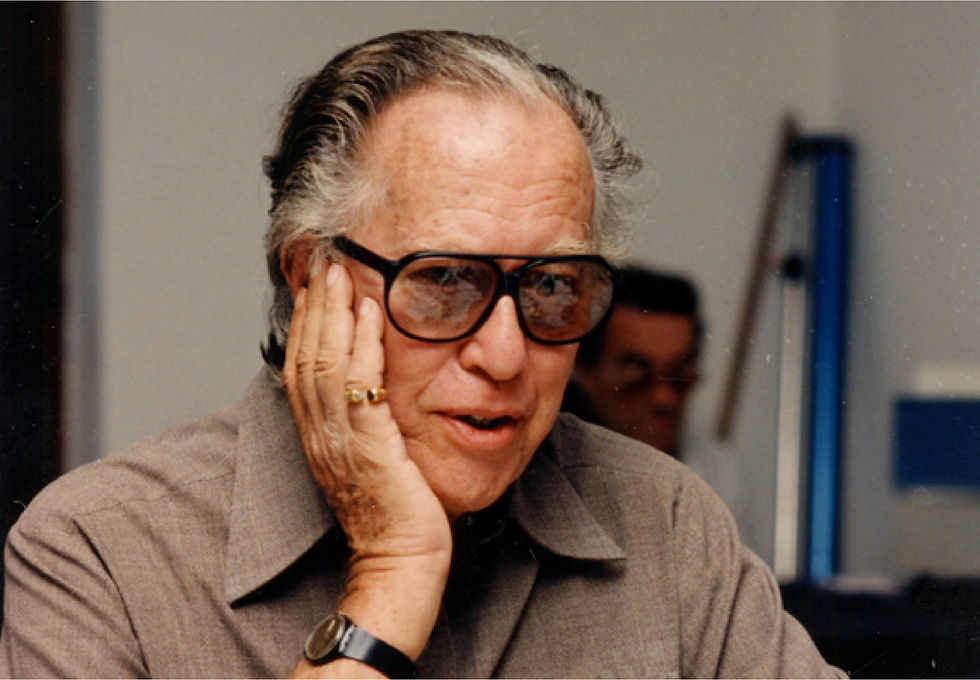
Geoffrey Bawa is considered one of the founders of Tropical Modernism, along with fellow Sri Lankan architect Minette De Silva. Seeing as we’ve already chatted about Minnette, it makes sense to continue our discussion about Tropical Modernism, or what some call Regional Modernism, with Geoffrey Bawa.
So what exactly is Tropical Modernism? In a nutshell, it’s a style of architecture in which some of the classic components of modernism have been modified to suit a different (often tropical) climate and unique methods of construction, but typically the open floor plan, un-decorated exterior and columns remain. Another equally important aspect of tropical or regional modernism is the incorporation of local construction techniques and traditional crafts into modern architecture. I prefer the term Regional Modernism because I think this more clearly describes this hybridized version of modern architecture that is distinctly influenced by the both the culture and climate of the place where the building is constructed.
So back to Sri Lankan architect Geoffrey Bawa. He is often mistakenly referred to as Sri Lanka’s first modernist architect but as previously stated, that honor goes to Minette De Silva who had been practicing modernism in Sri Lanka and India, for decades before Geoffrey became an architect. Geoffrey Bawa’s path to architecture was somewhat circuitous.
He was born in Colombo in 1919 into a wealthy family of indigenous Sri Lankan and Burgher ancestry. (The Burghers are a Eurasian ethnic group in Sri Lanka that is a mix of European and indigenous ancestry.) His father was a respected lawyer who held an important post in the British colonial administration. The similarities between Geoffrey Bawa’s family and Minette De Silva’s is quite striking. It’s a shame that Minette and Geoffrey couldn’t have been partners instead of competitors, surely they must have known one another.
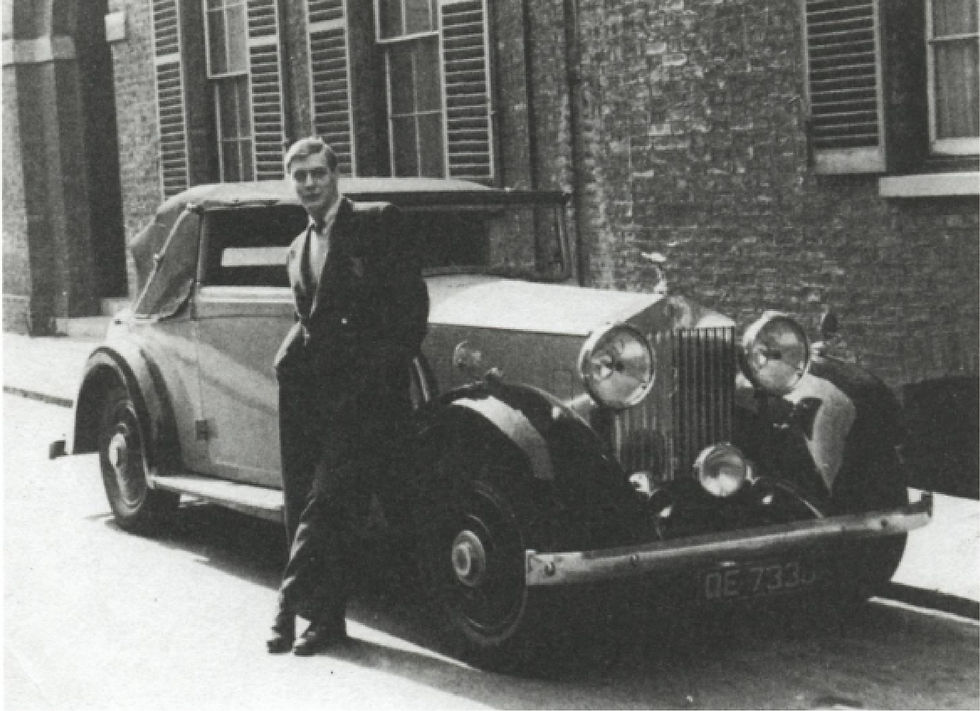
Geoffrey’s father died when he was seven, at which time his brother Bevis, who was ten years older, became the manager of their family’s estate, ending his studies to do so. Unlike his older brother, Geoffrey was able to complete his studies at King’s College in Colombo and in 1938 went on to study English literature and law at Saint Catherine’s College at the University of Cambridge. Geoffrey reveled in his new-found freedom at Cambridge and found a community in which he felt comfortable expressing his homosexuality. His friend Denys Johnson- Davies said this about him,
“He was from Ceylon and flouted the fact that he was gay. He dressed in a flamboyant style and spent as little time as possible in the college.”(1)
It’s no surprise that Geoffrey had an overly active social life as he was described as great fun by many. His long-time associate Ulrik Plesner, described him as incredibly witty even comparing him to Oscar Wilde. Ulrik said that Bawa was so funny his sides almost always ached from laughing by the time he got home from work. It’s clear even from photos that Bawa was an incredibly stylish man as well. During his Cambridge years he was described as carrying a cane and wearing a cape, resembling Oscar Wilde in appearance as well as wit. Despite all of this, Geoffrey continued along the path toward a law degree, as his parents wished, studying law at Middle Temple in London, and becoming a barrister in 1944. After he passed the bar he bought himself a Rolls Royce to celebrate. (This was the beginning of a lifelong love affair with Rolls Royce ) After WW II he returned to Sri Lanka (then known as Ceylon) to work as a lawyer, but it would appear his heart wasn’t really in it, and once his mother died he left the profession in1946 and traveled the world for two years.
In 1948 he returned to Sri Lanka (with his Rolls Royce) and bought an abandoned rubber estate called Lunuganga which he planned to turn into an Italianate garden, having fallen under Italy’s spell during his travels. Trying to create an Italianate garden in the tropical landscape of Sri Lanka with zero knowledge of either design, construction, or botany, turned out to be vastly harder than Geoffrey realized, and he decided that perhaps some work experience might be advisable. He quickly found an apprenticeship at the Colombo architecture office of Edwards, Reid, and Begg.

In 1953 Geoffrey enrolled at the Architectural Association in London and began his career as an architect in earnest. According to Max Moya's paper on Bawa's love affair with his Rolls Royce, he chose to live in Italy for his third year of architecture school and would drive back to England (in his Rolls Royce) when necessary. Sounds a bit apocryphal, but given his very posh lifestyle it could be true. He graduated from the AA in 1956 and in 1957 he returned to the office of Edwards, Reid, and Begg. He was made partner in 1958 and eventually took over the office. In 1959 Danish architect Ulrik Plesner, (who had formerly worked with Minettte De Silva),* came to work in the office bringing with him a modern Danish sensibility as well as years of practical experience and technical knowledge. Ulrik Plesner remained a close friend and partner until he left the country in 1967. He described their partnership as one of equals, in which they each possessed different but complimentary skills.

”Geoffrey saw architecture as an extension of landscaping by other means. He wasn’t interested in kitchens or toilets or foundations or any of that, but had a fantastic sense of space and planting and a very sure visual talent. We saw things the same way, we agreed on everything but I was the one who provided the practical foundation, the one who knew how it was done. How to make a door, how to make a window, how to make a roof, how to make the tree stand up. That’s why I said we went hand in hand like that. Later on when we separated we both missed the other half. None of the work we did subsequently, neither his nor mine, was as good as what we did together.” (2)
But it was not just design skills that differentiated the two men. Ulrik was the son of an architect and grew up in a modest household in Denmark, whereas Bawa grew up in extreme wealth in Sri Lanka.
“Because of his elite family background, Geoffrey never in all his life had to do anything for himself, anything menial, like picking up a pencil or a sketch that had fallen on the floor. That had to be done by others.” (3)
Despite this difference, their relationship was so symbiotic that many assumed (incorrectly) that Plesner was Bawa’s boyfriend.

In 1962 batik artist Ena de Silva, and her husband were looking for an architect to design a modest home for them in Colombo. They learned about Geoffrey through his older brother Bevis, whom they knew as a landscape designer. (Bevis had two careers; when he left the British Army in 1950, he began his career as a landscape designer.) Mrs. de Silva had seen the dashing Geoffrey tooling about town in his Rolls Royce, with his blond hair and silk scarf fanning out in the breeze behind him. She couldn’t really fathom working with such a dandy, but reluctantly agreed to meet with him anyway. To her surprise they got along famously and she agreed to give him the commission.

With its tiled pitched roof, central courtyard and deep overhang, the residence incorporated many elements of traditional Sri Lankan design. Un-glazed windows to provide constant airflow, stone floors to absorb the heat, and strategically placed water features to cool the air through evaporative cooling are just a few of the design elements to mitigate the high heat and humidity of Sri Lanka.

When these traditional design elements are used with an open floor plan and carefully choreographed views, the classic modernist style takes on a completely different character. It is this unique combination of traditional design with a modernist approach that defines r Regional Modernism. According to Ulrik Plesner, this hybrid form of modernism evolved over time. Both he and Bawa had started out strictly adhering to classic modernism, designing with flat roofs and small windows. ”At the same time Geoffrey did the AA building, an equally foreign building, and we were both equally dissatisfied. These buildings had nothing to do with the surrounding, the environment, the climate. They needed air conditioning. So that was the year we were both searching around. Le Corbusier’s hot concrete boxes in India were not an acceptable guide.”(2)

Like Minette De Silva,* Geoffrey Bawa incorporated as many local crafts as possible into his work. In the de Silva house he used batik textiles by Ena de Silva the homeowner, as well as wood carvings made by local crafts people and scavenged materials.
Ena de Silva and her husband lived happily in this home for decades. But in 2009 she wished to sell the land that the house was on. Fortunately the Geoffrey Bawa Foundation was able to buy the home from her, dismantle it and re-build it on Geoffrey Bawa’s estate Lunuganga. It has been converted to a guest house that can be reserved by the general public.
* In most of the literature the "D" in De Silva is capitalized in Minette De Silva's name. It is not in Ena de Silva's name.
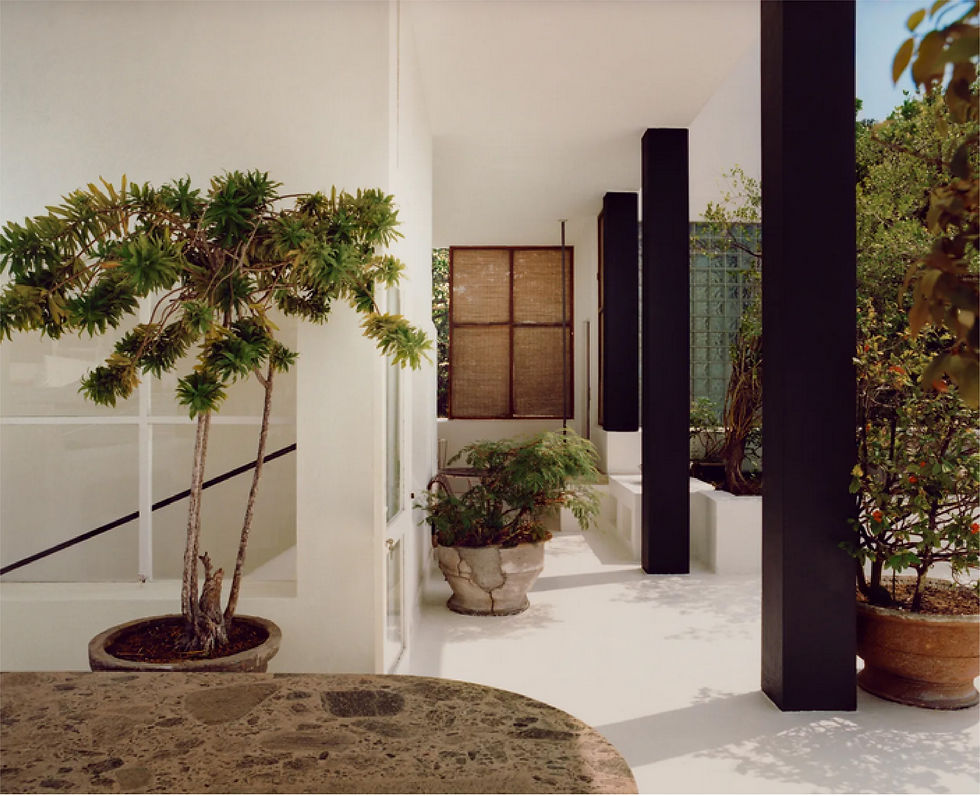
In 1958 Geoffrey Bawa bought a small bungalow for himself in Colombo and then managed to acquire three neighboring homes over the next decade, which he then converted into one large home for himself. With its glass block, white epoxy floors and black columns, the home that Geoffrey built for himself is clearly more modernist in its style and furnishings, yet the rooms are still arranged around a central courtyard typical of Sri Lankan homes. The interiors and exteriors flow together seamlessly allowing for a lifestyle centered around nature, reminiscent of the residences designed by California modernists such as Neutra or Pierre Koenig.

But in Bawa’s architecture, nature is allowed to run wild, unlike the carefully controlled nature of the California modernists.

The chair in the foreground was a reproduction of a Mies Van der Rohe chair that Bawa had made (as European designs were difficult to come by in Sri Lanka) and then covered in fabric by Sri Lankan designer Barbara Sansoni.

In another room he combines traditional colonial Sri Lankan furniture with a Sarineen Tulip Chair and side table and combines bamboo blinds with modernist sheer curtains hung from a ceiling track.

In his book “In Situ” Ulrik Plesner describes working with Geoffrey Bawa as the greatest experience of his professional life. Architect Gerhard Mayer also credits Bawa as being the most important mentor in his life.
”Bawa designed on-site, at full scale... He shaped vistas and sceneries, determined where colonnades would go, and the shops behind. He talked, gestured with his hands, scratched simple drawings into the dirt, and used his staff to mark locations. We then measured it all up after the fact and put it into drawings…I learned later, in Gehry’s office, to design with large-scale models. Frank maintained that architecture is a spatial art, not a graphic art focused on designing renderings, like so many architects do today. Still, I have not seen anybody design at full scale as Bawa did. It must have been like the cathedral builders of old, who could only proceed with a building by standing on the spot where the building would be built. It’s the only way to experience the “genius loci.” (4)
Although Bawa is most well known for his residential architecture in the west, within Sri Lanka he is famous for having designed the building that houses the Sri Lankan parliament.

To our contemporary eyes, perhaps some might find this building underwhelming, especially when compared with the Brutalist splendour of Le Corbusier’s Chandigarh. Geoffrey Bawa’s use of the traditional Sri Lankan pitched roof for a government building was rather novel at this time, given the popularity of the modernist flat roof for public buildings. The deep overhangs, and an exterior walkway shading all of the rooms as well as sliding doors to take advantage of tropical breezes was quite unheard for a building of this scale or importance.
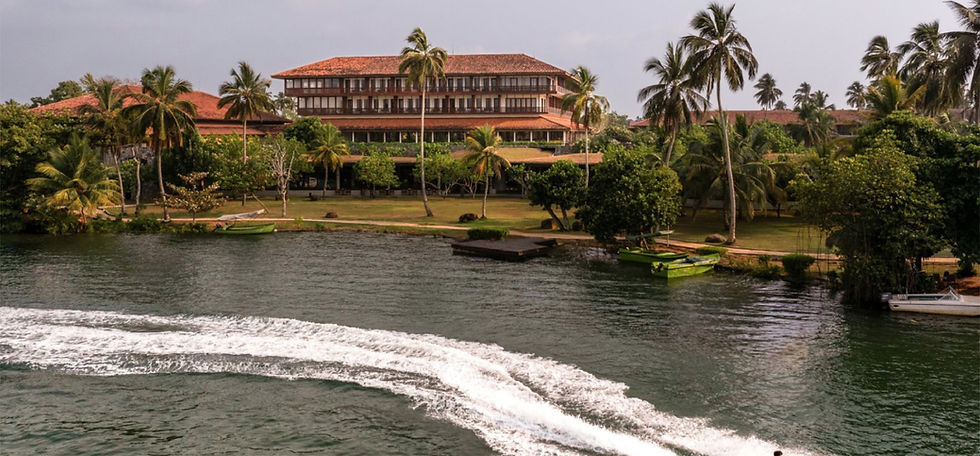
Bawa employed these same design elements in the Bentota Beach hotel built in 1969.He also used traditional Sri Lankan batiks and woven fabrics throughout the hotel interiors, which you will no doubt recognize from his residential projects.

The Bentotal Beach hotel looks as modern today as it did when it opened in 1969. It's important to remember that even in 1979, most hotels such as this Hilton in Waikiki Beach looked like this:

Geoffrey Bawa’s resort designs, inspired many larger hotel chains to completely change their resort template.
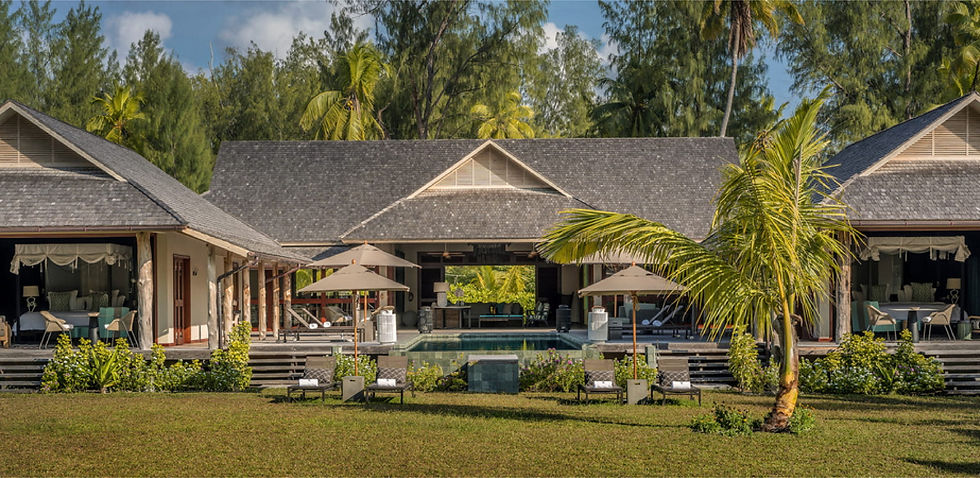
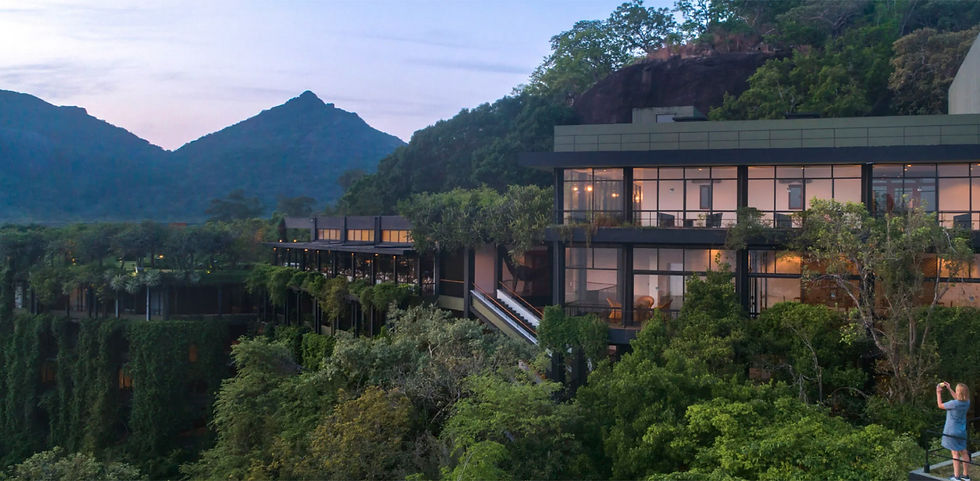
In 1991 Geoffrey Bawa designed the Kandalama Hotel in Dambulla, the first L.E.E.D.-certified green hotel in the world. Although it features the same overhangs, exterior breezeways, and sliding doors it does not have a pitched roof.

Instead it features a green roof, enabling the building to disappear into the landscape. Dambulla is a province in the center of Sri Lanka that is a Buddhist pilgramage site, famous for is cave temples. Nestled on the shore of Lake Kandalama, the hotel occupies a truly spectacular site, with lush jungles surrounding it and views of Dambulla Rock. Bawa designed the hotel to disappear into the backround so that the incredible landscape can take center stage.
Civil war broke out in Sri Lanka in 1983 and lasted until 2009. Although he closed down his office, Geoffrey Bawa remained in Sri Lanka and continued to work out of his home in Colombo on an astonishing amount of projects until his death in 2003. In his 2024 article on Bawa, writer Niru Ratnam makes the case that Geoffrey Bawa’s white, European appearance and tremendous wealth, provided him with an element of protection not available to other civilians, making it possible for him to stay and work in Sri Lanka in relative safety during this violent conflict.(5) It is interesting to compare the trajectory of Geoffrey Bawa with that of his modernist predecessor Minette De Silva, who was not white and wore a traditional sari rather than western clothing throughout her career. Minette’s father was an important lawyer in Sri Lanka, and her entire family was involved in the fight for independence from British colonial rule. Once Sri Lanka became independent, her father had an important role in the post Colonial government. Geoffrey Bawa’s father, held an important post in the British colonial administration and died before the fight for independence began. Geoffrey did not participate in any of the protests, as he was in England continuing his law studies at this time. Despite his father’s position in the British administration, and his own lack of involvement in the fight for independence, Geoffrey Bawa achieved much greater fame than Minette De Silva, and was invited by Sri Lanka's second president, J. R.Jayewardene to design Sri Lanka’s parliament building. Geoffrey Bawa received the Sri Lankan Institute of Architect's gold medal in 1982, while Minette received hers in 1996.
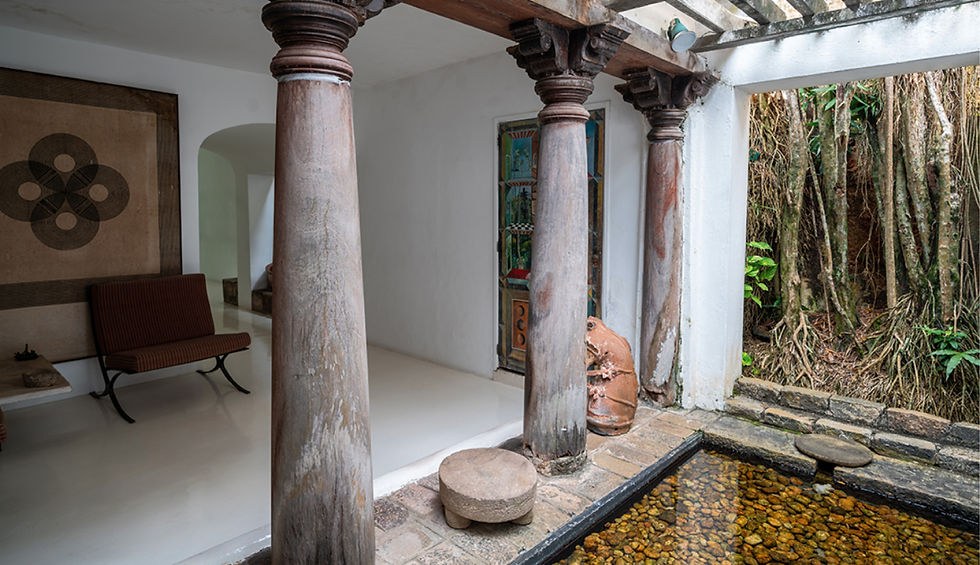
There is no denying the beauty of Geoffrey Bawa’s work. His projects exquisitely bridge modernism and traditional Sri Lanka building styles, bringing a warmth to his architecture that is often lacking in classic modern buildings. Equally important is the connection between his projects and the landscape surrounding them, another quality that classic modernism (and especially modern urban planning) often got incredibly wrong with dire consequences. It’s a shame that Geoffrey Bawa was relatively unknown outside of Sri Lanka, until recently. There was so much that Western modernism could have learned from his work.

In his 2008 interview with the Sri Lankan Sunday Times Ulrik Plesner stated
”Minette met me in her little Ford Anglia and we drove all the way back to Kandy…Within a couple of days I was in love with everything. I was in love with Kandy, I was in love with Minette. And I never went out of love. It was the happiest period of my life!”
I don’t know if he is speaking literally or not about his love for Minette. Perhaps I will find out when I get my hands on his memoir, which is currently out of print. Either way, the “Playboy Architect of the Eastern World” (as The Architectural Review refers to him) deserves his own post.
Thirsty For More? Get the recipe for a delicious cocktail, that pairs perfectly with Tropical Modernism here.
Want to stay in a Geoffrey Bawa designed home, or perhaps just visit his estate Lunuganga? Head on over to the Geoffrey Bawa Trust:https://geoffreybawa.com/number-05
Shoppables
Sources
1.Darling, Harper -Hugo et al. “Geoffrey Bawa” August 2020https://www.makingqueerhistory.com/articles/2020/8/28/geoffrey-bawa
2. Modi,Deepali and Ferrey, Ashok ”If there Was a Bawa there Was a Plesner” Interview with Ulrik Plesner for the Sunday Times Sri Lanka, 2008 3. Prins, Stephen, "Built to Please" interview with Ulrik Plesner for The Sunday Times Sri Lanka, 2013
4.Mayer, Gerhard. “In Praise of Great Mentor: Working With Geoffrey Bawa.” 08.24.2023. Retrieved from Common Edge https://commonedge.org/in-praise-of-a-great-mentor-working-with-geoffrey-bawa/
5.Ratnam, Niru. “Open and Shut Case.” World of Interiors May 2024
Additional Sources
Filler, Martin. “Under Sri Lanka’s Big Roof” 2013 The New York Review of Bookshttps://www.nybooks.com/online/2013/05/29/sri-lanka-bawa-plesner/
Moya, Max. “Bawa’s Rolls”. Architectural Association School of Architecture https://architecture-history.org/library/AJ/Bawa%27s%20Rolls.pdf
Ulrik Plesner. In Situ-An Architectural Memoir From Sri Lanka. Aristo Publishing 2013


Comments